The European Central Bank announced it would stop producing the €500 note by the end of 2018, amid fears that its high value facilitated criminal activity.
There are five leading candidates - from across the political spectrum - who will contest the first round of voting on 23 April and unless one candidate wins more than 50% of the votes, the two leading contenders will then go through to a second round on 7 May.
So who are the candidates and what are the issues likely to decide this election?
The candidates
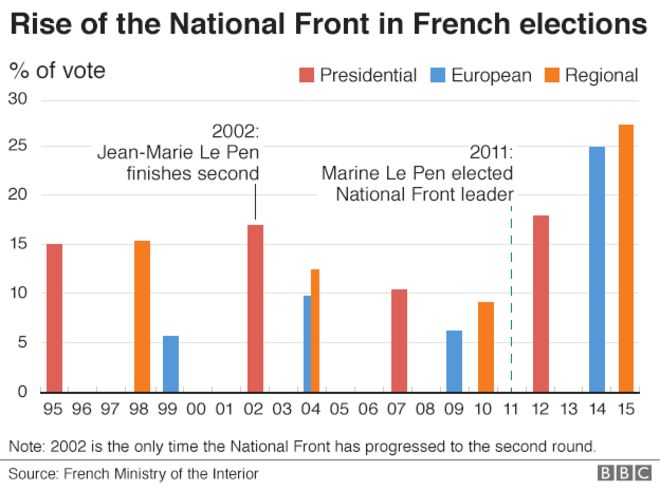
On the far right, the National Front's Marine Le Pen appears to have achieved more electoral success since distancing herself from some of her father's more extreme xenophobic policies.
Latest opinion polls show Ms Le Pen is ahead of the other four candidates in the first round - though a long way short of 50% - and is therefore likely to get through to the run-off.
In 2002, Jean-Marie Le Pen got through to the second round, but lost to Jacques Chirac.
Opinion polls currently suggest Marine Le Pen would be defeated in the second round byEmmanuel Macron. Without the backing of a traditional political party, the former economy minister, who has never held an elected office, is standing as a centrist candidate.
The previous front-runner, centre-right Republican Francois Fillon, has lost support over allegations his wife and children were paid public money for jobs they never had.
Prosecutors have launched a full judicial inquiry into the affair but he has survived an attempt within his party to replace him as candidate.
Socialist and former education minister Benoit Hamon, with a reputation as a left-wing rebel, has a plan to introduce a universal income which would be rolled out initially to those on a modest income, being expanded to all French citizens some time after 2022.
Far-left candidate Jean-Luc Melenchon has the backing of the French Communist Party and stood unsuccessfully for the presidency in 2012.
Unemployment
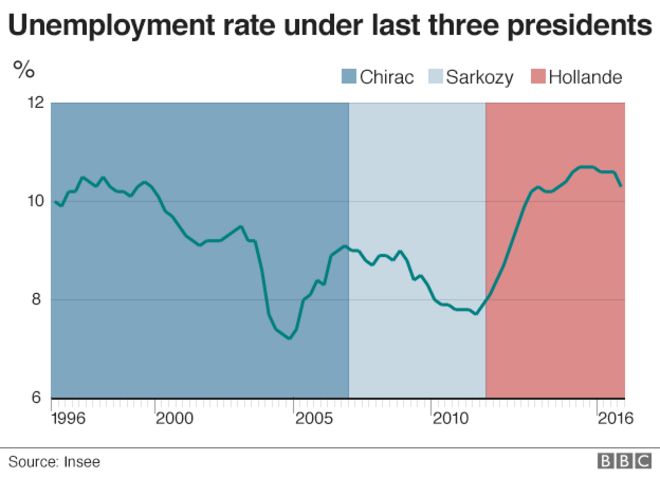
One of the overriding issues facing French voters is unemployment - with at least one in four people aged under 25 unemployed.
The national rate stood at 10% in the last quarter of 2016 and according to the French official statistics office, Insee, it fell over the year by just 0.2%.
Latest unemployment figures for the European Union show France had the 8th highest jobless rate out of the 28 member states in December - and more than double that of Germany and the UK.
Last year's slight fall in the jobless rate came too late for President Francois Hollande, who had staked his reputation on creating more jobs during his time in office. Faced with very low ratings in the polls, he pulled out of the election race - the first French president not to run for a second term in modern history.
The problem of reducing unemployment will now fall to his successor.
Economy
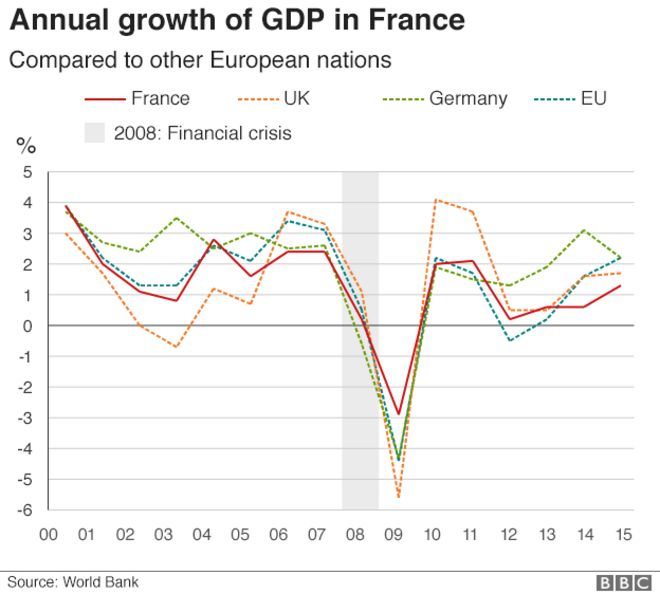
The French economy is the second-biggest in the eurozone - but its recovery from the financial crisis of 2008 has been slow.
One of Mr Hollande's key policies was a new labour law, intended to help boost the economy by giving firms greater freedom to increase regular working hours, reduce pay and lay off workers.
But measures were watered down to get the bill through and the hoped-for improvements in the economy have not yet materialised.
France's economy, measured in terms of its Gross Domestic Product, has continued to lag behind its closest European neighbours, Germany and Britain.
All the leading candidates have argued that deep changes are needed in the French economy.
Security
Security and immigration are also high on the agenda in this election.
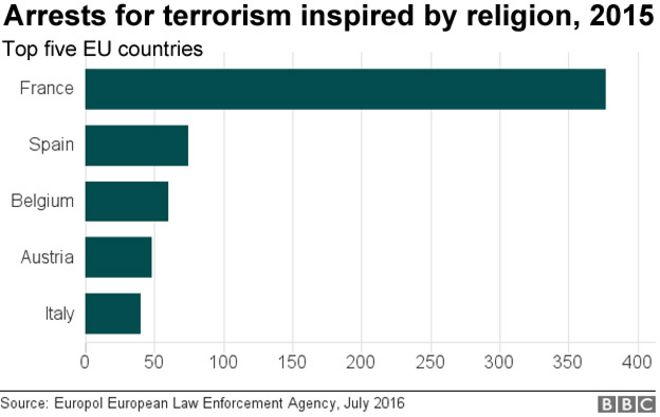
France is still in a state of emergency following a number of terror attacks, including 14 July last year when 86 people died as a lorry ploughed into a crowd in Nice celebrating Bastille Day.
More than 320 people have died in terror attacks in France since January 2015.
Hundreds of young French Muslims are known to have travelled to Iraq and Syria to fight for so-called Islamic State. Interior ministry figures say almost 700 French citizens are still in the region - although numbers have dropped off in the past year.
Some of the perpetrators of the Paris attacks in November 2015 are known to have travelled to Syria - French officials fear others who have been radicalised may now return to France to commit further atrocities.
Immigration
Tens of thousands of migrants have arrived in France as a result of the crisis which began in 2015, largely as a result of people fleeing the conflicts in Syria and Iraq.
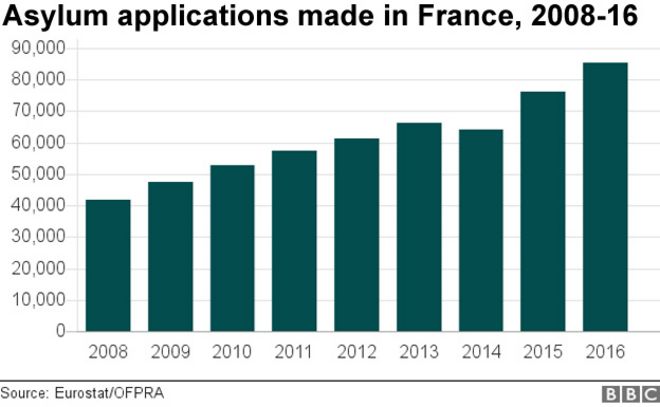
France received more than 85,000 applications for asylum in 2016 - more than 5,800 came from Syria. Although the figure has been rising steadily, the number of asylum-seekers applying to stay in France is lower than other European countries like Germany.
There is no official breakdown of the figures, as it is illegal in France to collect data on race and religion, but there are thought to be about five million Muslims living in France, thebiggest Muslim population in the EU.
The majority of France's Muslim population live in the poorer suburbs of big cities like Paris, Marseille and Lyon, where unemployment is much higher than the national average.
The National Front has made treatment of immigrants one of its key policy issues - saying jobs, welfare, housing and school places should go to French nationals before "foreigners". A Pew Research Center survey in 2016 indicated that 29% of French adults viewed Muslims unfavourably.
French presidential candidate Francois Fillon has suffered another blow as his campaign manager quit late on Friday.
Patrick Stefanini said his resignation will take effect on Sunday night.
Earlier, the Union of Democrats and Independents (UDI) called on Mr Fillon's Republican Party to choose another candidate in the wake of a scandal over payments.
It is alleged his wife and children were paid for parliamentary work they never carried out.
Details of his campaign chief's departure emerged when the French newspaper Journal du Dimanche published Mr Stefanini's resignation letter.
In it, he gave two reasons - writing that he had advised Mr Fillon to cease his campaign after an investigation began into his financial affairs.
After Mr Fillon decided to continue, he found himself in a minority in his political team, he wrote, and "no longer in the best position to lead your campaign".
The other reason, he wrote, was that Mr Fillon could no longer be certain of not being eliminated in the first round of voting.
Image copyrightAFPImage captionPatrick Stefanini, left, said the victory of Mr Fillon, right, was no longer certain
Mr Fillon has already lost several key members of his campaign team, and several MPs from his own party are campaigning to replace him with Alain Juppe.
Mr Juppe lost the November primary election to Mr Fillon.
But despite the increasing pressure, Mr Fillon, 62, denies any wrongdoing and says he is the victim of a "political assassination".
The loss of support from the UDI represents a major challenge for his campaign.
The BBC's Paris correspondent, Hugh Schofield, said that while the UDI is a small party with 28 MPs, its alliance with the Republicans is important.
As a centrist party, it broadens the Republicans' base, he said.
UDI leader Jean-Christophe Lagarde said Mr Fillon had become a liability, and that as long as he was a candidate, the centre-right was heading for certain failure.
Separately, National Front candidate Marine Le Pen has refused to attend a summons over misuse of EU funds.
Her legal advisers said she would not attend before the election. "Of course she won't go," her lawyer told reporters.
Image copyrightEPAImage captionMs Le Pen maintains the allegations against her are politically motivated
Ms Le Pen's party is accused of misusing more than €300,000 (£257,000; $321,000) of European Parliament funding.
As a Member of the European Parliament (MEP), Ms Le Pen is immune to prosecution during sessions of the parliament - a measure designed to ensure the independence of members and protect them from pressure in form of legal threats.
The European Parliament can vote to lift Ms Le Pen's immunity - as they did on Thursday regarding her use of images of violence carried out by so-called Islamic State.
However, the parliament would have to carry out the same procedure again to lift her immunity on the EU funds investigation.
The legal issues surrounding both candidates have lifted the prospects of a third contender - centrist Emmanuel Macron.
On Friday, a poll showed Mr Macron finishing ahead of Marine Le Pen in the first round for the first time - though the pair remain close in popularity.
The election takes place in two rounds in April and May. If no candidate achieves a majority in April, a run-off election will take place between the top two the following month.